
Phnom Penh is a city defined by its relationship with water, situated at the confluence of the Mekong, Tonle Sap, and Bassac rivers. Historically, this geography presented a challenge to urban expansion, creating isolated pockets and choking intersections with traffic dependent on a few critical crossings. Over the past two decades, and accelerating rapidly in the mid-2020s, the capital has undergone a profound transformation.
This transformation is driven by a massive investment in bridges, both major river crossings that “bridge the divide” to new satellite cities, and “sky bridges” (flyovers) that untangle the city’s congested arterial roads. As of March 2026, Phnom Penh boasts a sophisticated network of completed bridges, with several more landmark projects under construction or in the final planning stages.
This article provides a comprehensive guide to Phnom Penh’s bridges, categorized by type, detailed by their construction timelines, and analyzed for their immense impact on the city’s economy and real estate landscape.
Chroy Changvar Bridge I (Cambodia-Japan Friendship Bridge)
- Construction Start: 1963
- Completion: 1966 (Original) | Reopened February 1994 | Major Renovation April 2019.
- Details: The pioneer bridge of the capital, symbolizing post-war reconstruction with Japanese support.
Chroy Changvar Bridge II (Cambodia-China Friendship Bridge)
- Construction Start: November 2011
- Completion: October 2015
- Details: Built parallel to the Japanese bridge to handle the massive surge in traffic toward the 6A residential corridor.
Russey Keo Bridge (Cable-Stayed)
- Construction Start: October 2017
- Completion: June 2023
- Details: A modern architectural landmark linking National Road 5 to the Chroy Changvar Satellite City, significantly boosting the value of riverside condos in the north.
Prek Pnov Bridge (Ly Yong Phat Bridge)
- Construction Start: 2011
- Completion: September 2013
- Details: A vital northern crossing that allows heavy logistics and regional transport to bypass the central core.

Koh Pich Satellite City
Spanning the Bassac River (Southbound)
These crossings connect the main city to the Chbar Ampov and Koh Norea areas, leading toward National Road 1 and the new international airport.
Monivong Twin Bridges (Old & New)
- Timeline: Original (1960s) | New Span (2008 – January 2009).
- Details: The city’s primary southern gateway, connecting Monivong Blvd to National Road 1.
Prek Samrong Bridge (Takhmao Bridge)
- Construction Start: January 2012
- Completion: August 2015
- Details: A crucial link for the southern ring, connecting the capital’s outskirts to the industrial and residential growth in Takhmao.
Koh Pich–Koh Norea Bridge
- Construction Start: October 2020
- Completion: October 2023
- Details: This cable-stayed bridge transformed the southeast, turning Koh Norea into one of the most expensive and desirable real estate zones in the country overnight.
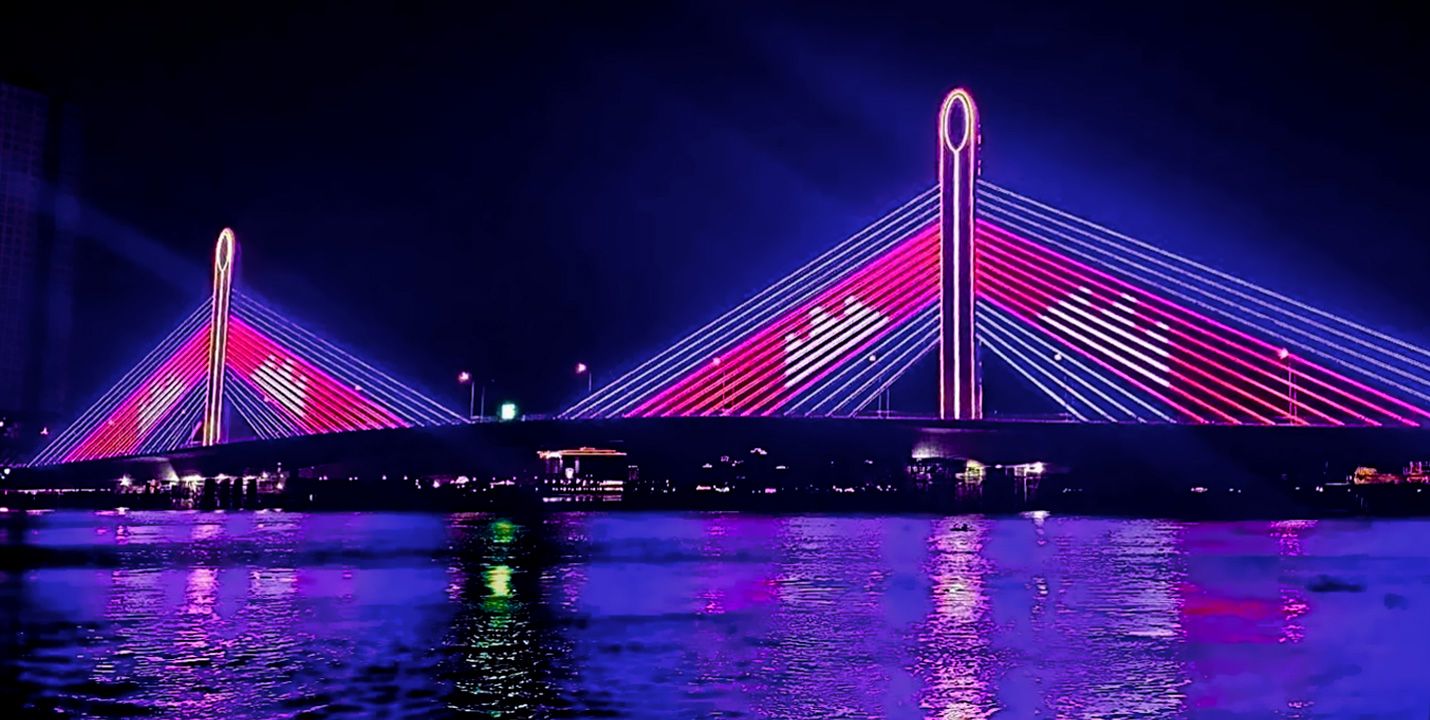
Koh Pich-Koh Norea Bridge
Inner-City Flyovers (Sky Bridges)
Phnom Penh’s “sky bridges” have become ubiquitous since 2010, designed to manage high-volume, multi-directional traffic flow at the city’s most choked intersections.
Kbal Thnal Flyover (June 2010): The first ever, located near the Monivong Bridge.
7 Makara Flyover (January 2012): Clears the Pet Lok Sang intersection (St. 271/Russian Blvd).
Stung Meanchey Flyover (May 2014): A multi-level interchange in a high-density area.
5 January Flyover (January 2016): Located at the Techno Intersection on Russian Blvd.
Phsar Dei Huy Flyover (July 2018): Essential for the boom in the Sen Sok district.
Chom Chao Interchange (March 2022): A complex system of loops and underpasses near the old airport.
Russey Keo Flyover (July 2023): Built to streamline traffic coming off the new river bridge onto NR5.
Preah Monivong Flyover (August 2025): A massive three-level interchange at the 60m Road junction.
Morodok Techo Flyover (March 2025): Facilitates high-speed transit toward the new Techo International Airport.
Kong Sam Ol Flyover (June 2025): Located at the Century Plaza intersection (St. 2004/Russian Blvd).
Samdech Thipadei Hun Manet Flyover (January 2026): The newest addition, serving the southern expansion corridor.
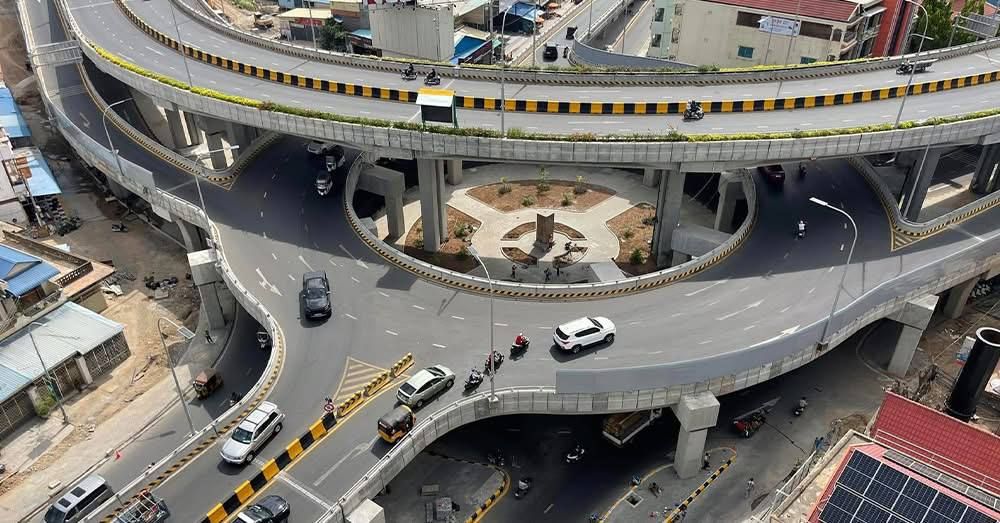
Preah Monivong Flyover
Under Construction & Planned Projects
The momentum shows no signs of slowing. As of early 2026, the next generation of mega-projects is already making visual progress.
Chak Angre Krom–Prek Pra Bridge
- Timeline: Feb 2024 (Start) – Estimated Completion Late 2026.
- ទីតាំង៖ Connecting Khan Meanchey (West) to Khan Chbar Ampov (East).
- Technical Details: 845.7 meters long (bridge only) and 27 meters wide.
- Budget: Approximately $60.2 Million (funded by China).
- Impact: Will provide a vital second crossing for Chbar Ampov, significantly easing the load on the Monivong Bridge.
Third Ring Road Mekong Bridge (Dei Edth–Thmar Kor)
- Timeline: Late 2023 (Start) – Estimated Completion Feb 2028.
- ទីតាំង៖ Linking Kien Svay (NR1) to Lvea Em district.
- Technical Details: 3.7 km total length (1,600m main span) and 26 meters wide.
- Budget: Approximately $273 Million (part of the Third Ring Road project).
- Impact: A massive industrial link allowing cross-country freight to bypass the city center entirely.
Cambodia-Korea Friendship Bridge
- Timeline: Groundbreaking June 2025 – Estimated Completion 2030.
- ទីតាំង៖ Two sections: Night Market to Chroy Changvar, and Chroy Changvar to Arey Ksat.
- Technical Details: 2.37 km total length and 27.5 meters wide.
- Budget: Approximately $245.9 Million (funded by South Korea).
- Impact: Expected to trigger the largest land-value spike in the city’s history by integrating Arey Ksat into the CBD.
Koh Norea–Mekong Quay Bridge
- Timeline: Study Phase (Jan 2026) – Estimated Construction 2027–2030.
- ទីតាំង៖ Connecting Koh Norea Satellite City to Mekong City (Arey Ksat).
- Technical Details: Approximately 2 km long (Preliminary study).
- Budget: Estimated $150 Million – $200 Million (Private-Public Partnership).
- Impact: Designed by OCIC and TP Moral to create a high-end luxury corridor across the Mekong, linking two major satellite cities.
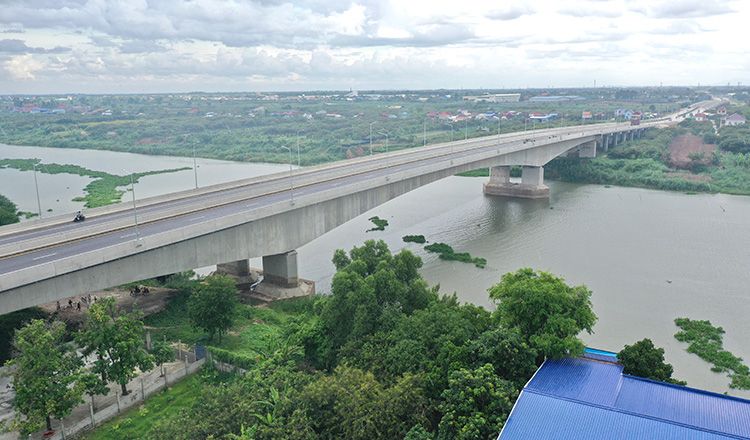
Third Ring Road Mekong Bridge Under Construction
Transformative Insights: The Economic and Real Estate Ripple Effect
The benefits of this aggressive bridging strategy extend far beyond simply moving traffic faster. These bridges are fundamental catalysts reshaping Phnom Penh’s economic and real estate landscape.
Unlocking Land and Creating New Satellite Cities
Historically, millions of square meters of land directly across the river from downtown were isolated, accessible only by slow ferries. Bridges have fundamentally changed this.
- Example: Chroy Changvar. Following the completion of the Japanese and Chinese bridges, Chroy Changvar transformed in a decade from a rural peninsula into one of Phnom Penh’s most sought-after satellite cities. It now hosts multi-billion-dollar developments, luxury condominiums, standard boreys (gated communities), medical centers, and top-tier educational institutions.
- The Next Frontier: Arey Ksat. The upcoming Cambodia-Korea bridge to Arey Ksat is already triggering massive speculative interest. Land values in Arey Ksat, once isolated by the Mekong, have seen steady appreciation since the official project confirmation. Developers are rushing to secure plots, and massive, “smart city” style satellite developments are already in the planning, expected to replicate or even surpass the Chroy Changvar model.

Koh Norea Island
Fueling a Real Estate Boom and Soaring Property Prices
Improved accessibility translates directly into higher property value. Every major bridge project in Phnom Penh has been followed by a tangible real estate ripple effect:
- Land Value Increases: In regions previously dependent on ferries, land values have often doubled or even tripled within a 3-5 year window following a bridge announcement and opening. Areas like Koh Norea saw exponential land price growth immediately following the start of construction on the link from Koh Pich. We anticipate similar, albeit staggered, appreciation along the path of the new Prek Pra crossing.
- The Shift in Development Focus: Developers are no longer restricted to the city core. This has allowed for the creation of massive, master-planned gated communities (Boreys) and mixed-use complexes in the outer ring of the capital, particularly in areas like Chbar Ampov and Sen Sok, which were unlocked by better river crossings and flyovers, respectively.
- The Rise of Secondary Investment Hubs: Secondary cities like Takhmao have been brought into the capital’s orbit by projects like the Prek Samrong bridge and the new airport-accessible flyovers, attracting industrial investment and more affordable housing developments that were not viable before.
Boosting the Economy and Attracting Foreign Direct Investment (FDI)
The infrastructure boom has had a multi-layered impact on the national economy:
- FDI Magnet: The sheer scale and success of master-planned satellite cities unlocked by bridges (e.g., OCIC’s Koh Pich and Koh Norea projects) demonstrate stability and future growth potential to international investors. This, in turn, attracts further foreign investment into construction, retail, hospitality, and finance.
- Reduced Logistics Costs: Inner-city flyovers and major northern bypass bridges like Prek Pnov have untangled logistics bottlenecks. This has directly reduced transit times for goods flowing between the capital’s industrial zones and the primary deep-sea port in Sihanoukville, making Cambodian exports more competitive.
- Job Creation: The construction of the bridges and, critically, the sub-developments they unlock, provides hundreds of thousands of jobs for Cambodians, serving as a pillar of economic stability during global downturns.
Phnom Penh’s bridge network is the visible skeleton of its rapid transformation into a world-class, multi-nodal metropolis. By unlocking land, increasing connectivity, and enabling master-planned development, these bridges are doing much more than moving people, they are bridging the future of the nation’s economy and creating immense, long-term real estate opportunity.
Contact Us Directly:
- Telegram / WhatsApp: +855 77 959 861
- Email: inquiry@ips-cambodia.com
- Visit Our Office: No. 182 Street 63 (Corner of St. 294), BKK1, Phnom Penh
- Our Telegram Channel: IPS Cambodia (អាភីអេសខេមបូឌា)
- Our Social: YouTube, ហ្វេសប៊ុក, LinkedIn
