
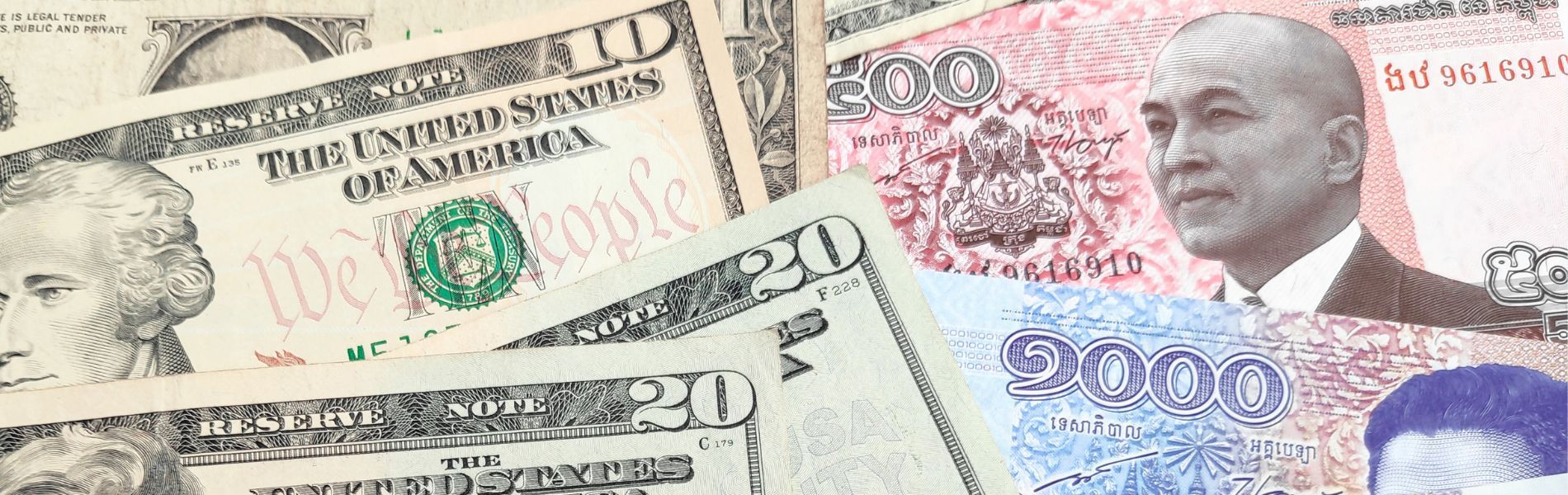
Besides finding the right real estate to rent or buy in Cambodia as an expat, you also need to figure out what your finances will be like. Making sure that you have easy access to your money and can pay for your wants and needs without worries should be your priority to make living in the country more convenient for you.
Prepare yourself better and make smart financial decisions when you know the complete guide to finances as an expat here in IPS Cambodia.
Currencies used in Cambodia
In Cambodia, the official currency used is Riel (KHR) and it’s accepted in most places, especially in rural areas. However, another commonly accepted currency is the United States Dollar (USD). This is used in business transactions, hotels, restaurants, and in major cities like Phnom Penh.
Common payment methods
Cambodia is a developing country that has consistently improved its economy in the last decade. Similar to this, Cambodia has adopted numerous technologies to make daily life more convenient for locals and expats alike, including different payment methods. See below the top commonly accepted payment methods in the country:
QR and Mobile Payment
Since the pandemic hit, Cambodia has seen widespread adoption of QR code payments and mobile banking. With the touch-free nature of QR code payments, customers can easily make transactions using their smartphones or other mobile devices. This innovative payment method has become increasingly popular, providing convenience and safety for both consumers and businesses alike.
As a result, QR code payments and mobile banking have quickly become an integral part of everyday life in Cambodia, and they continue to gain momentum as a preferred payment method in the country.
Cash
Before online payments has been popular, the most common payment method in Cambodia is cash. Whether you want to pay using KHR or USD, some businesses or establishments prefer accepting cash when you buy their goods or services.
Withdrawing cash in ATMs is easy since there are hundreds of machines located in the country. If you have a local Cambodian bank card, you have the option of withdrawing cash either in USD or KHR currencies without additional charges. On the other hand, if you withdraw money using an international card, your card is subject to a transfer fee ($5 transfer fee in most ATM banks).
Local banks in Cambodia generally offer withdrawals in both USD and Cambodian Riel (KHR) at their ATMs. For a standard card withdrawal, the ATM typically gives you the option to select which currency you want, regardless of the amount. The specific $100 USD threshold is not the universal rule for all transactions. Instead, this minimum amount of $100 USD or KHR 50,000 is required for a single transaction when using the E-Cash service (cardless withdrawal via the mobile app). For standard card withdrawals, you can usually withdraw smaller amounts in your preferred currency, assuming the ATM is stocked. (Updated 11/15/2025)
Credit and debit cards
Following cash, the second most accepted payment method in establishments and stores are debit and credit cards. These cards are commonly accepted in areas within Cambodia that are popular with tourists like Siem Reap and Phnom Penh. Whether you go to a high-end store or mid-end, you can use these cards to pay.
However, if you go outside popular tourist areas, they might not be accepted. Additionally, if you use a credit card to pay, there is an extra charge between 2% to 4% on your bill.
Traveller’s check
Similar to other countries, you can use your traveller’s check to pay for hotels and restaurants in Cambodia. Most banks and some money exchange places also accept it so you can easily buy anything you would need or want. The most widely accepted traveller’s check in the country is American Express.
Online banking
Over the last few years, online banking has been integrated into banks and accepted into a variety of stores. Most banks offer online banks to schedule payments, transfer funds or pay bills, but this hasn’t been adopted yet into daily transactions in the country. Some banks that offer this are ACLEDA, FTB, and Canadia Bank.
What you need to know about banking
In order to achieve seamless financial transactions, you need to know more about banking in Cambodia. While you can still use your international card to pay, there are numerous perks to having a local bank account. Continue reading below on why you need a local bank, transaction fees, and requirements to open an account.
Local vs International bank
Using your international bank card to pay for transactions in Cambodia is possible and convenient. After all, you don’t have to set anything up and process a new bank application since this is accepted in most places. However, you have to consider that there are costly convenience fees, automatic currency conversion fees if your home currency isn’t USD, and others.
If you have a local bank account, the convenience fees are less and you don’t have to worry about currency conversion fees since your money (whether USD or KHR) will be exactly as it is in your bank.
Requirements to open an account
It’s easy to open a bank account in Cambodia since you only need to bring proof of identification like your passport, visa and minimum deposit amount for the account. However, there are some banks that require you to bring other items so it’s best to prepare the following:
- Valid passport
- Visa
- Deposit amount
- Certificate of employment or photocopy of your business registration
- Photocopy of your rental agreement
- A passport size photo of yourself
READ ALSO: Opening a Bank Account in Cambodia as an Expat
Withdrawal transaction fees
When you use a local bank account to withdraw from its ATM, you do not need to worry about convenience fees. However, if you withdraw using an international bank card, the convenience fee for the transaction can range from $4 to $8 USD, depending on the local bank’s ATM. It is advisable to choose banks that offer lower fees and higher withdrawal limits (up to $2,000 in some cases) to minimize costs.
Taxes as an expat
Whether you’re officially considered as a resident in Cambodia or not, foreigners are still expected to pay taxes (Tax on Salary, or TOS). If you’re employed or have a business, you’ll encounter income tax or business tax. Additionally, VAT, which are taxes on merchandise and services, are something that you’ll pay for.
The basic tax added for VAT depending on the products or services are the following:
-
Cigarettes and alcoholic/non-alcoholic beverages → 10%
-
Entertainment services → 10%
-
Air transportation services → 10%
-
Telephone services → 3%
-
Accommodation Tax → 2%
Meanwhile, income tax depends on your monthly salary as you can see below:
- 0 to 500,000 KHR → 0% tax
- 500,001 to 1,250,000 KHR → 5% tax
- 1,250,001 to 8,500,000 KHR → 10% tax
- 8,500,001 to 12,500,000 KHR → 15% tax
- 12,500,001 KHR and above → 20% tax
Meanwhile, Monthly Income Tax (Tax on Salary) depends on your monthly salary for resident taxpayers as you can see below (non-residents are subject to a flat 20% rate):
- 0 to 1,500,000 KHR → 0% tax
- 1,500,001 to 2,000,000 KHR → 5% tax
- 2,000,001 to 8,500,000 KHR → 10% tax
- 8,500,001 to 12,500,000 KHR → 15% tax
- Greater than 12,500,000 KHR → 20% tax
If you have your own business located in Cambodia, the tax rates based on annual income generated are as follows:
- 0 to 18,000,000 KHR → 0% tax
- 18,000,001 to 24,000,000 KHR → 5% tax
- 24,000,001 to 102,000,000 KHR → 10% tax
- 102,000,001 to 150,000,000 KHR → 15% tax
- 150,000,001 KHR and above → 20% tax
To learn more about banking and finances involved in Cambodia real estate, visit one of the local banks popular for expats listed here.
