
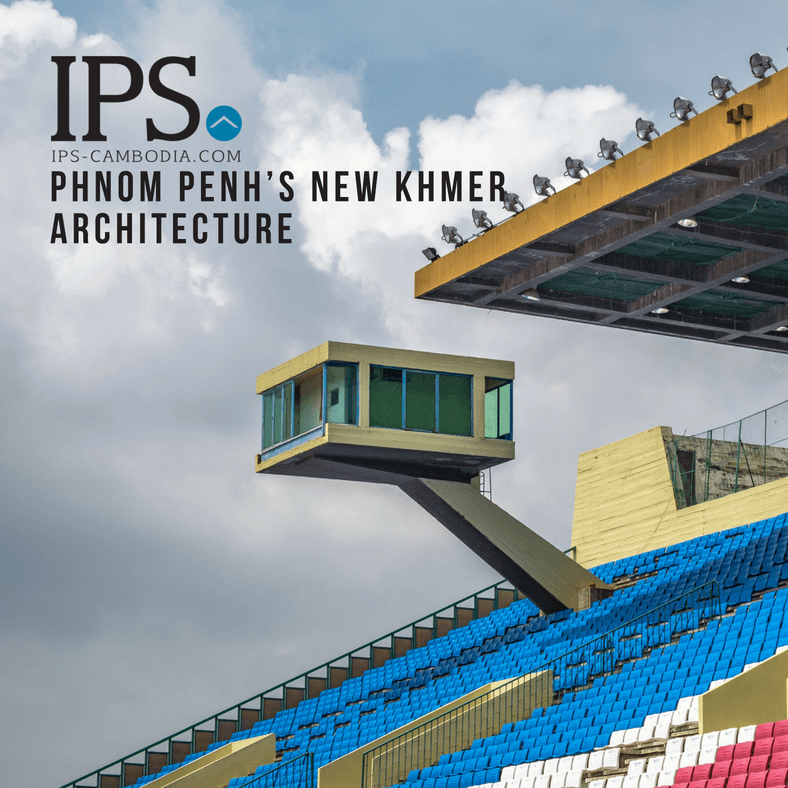
Dotted around Phnom Penh are the remains of a vernacular expression of European modernist architecture, known as New Khmer.
The figurehead of this movement was Vann Molyvann who studied architecture in post WWII Paris at the Ecole Nationale Supérieure des Beaux-Arts, where the work and thinking of Le Corbusier had a strong influence.
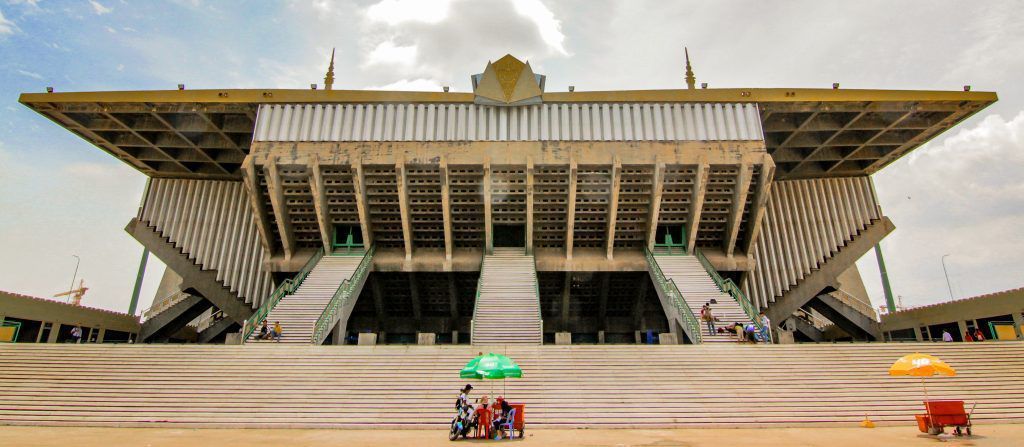
New Khmer architecture combines truth to structural materials and refined simplicity of modernism with sensitivity to climate and geography specific to traditional Khmer buildings, such as the world renowned temples of Angkor Wat.
Buildings such as Molyvann’s Teachers Training College (now the Foreign Language Institute) and the Olympic Stadium, both demonstrates that modernism could be at once international and idiosyncratic.
While the links to regionally specific buildings can be made at both functional and stylistic levels, the buildings are realised with a confidence that allows them to transcend the limitations of context. The striking repetition of abstract geometrical forms and paradoxical combination of the skeletal and the muscular, of lightness and heaviness, allow both the Training College and the Stadium to exert an influence that is wholly their own. In this sense, Molyvann’s work demonstrates the tension between “the inherent striving of form to achieve complete autonomy” (Koltz, 1988) and the customs of making on which humans inevitably depend for their inspiration.
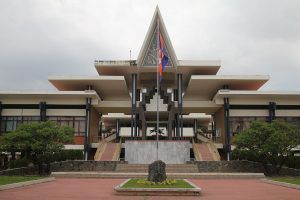 At an impressionistic, aesthetic level, the Training College resembles something from the set of a science fiction film as much as it does the traditional Khmer vernacular. The discrete classrooms or “pods” seem as though they have landed on the site, floating on diagonal, cement stilts.
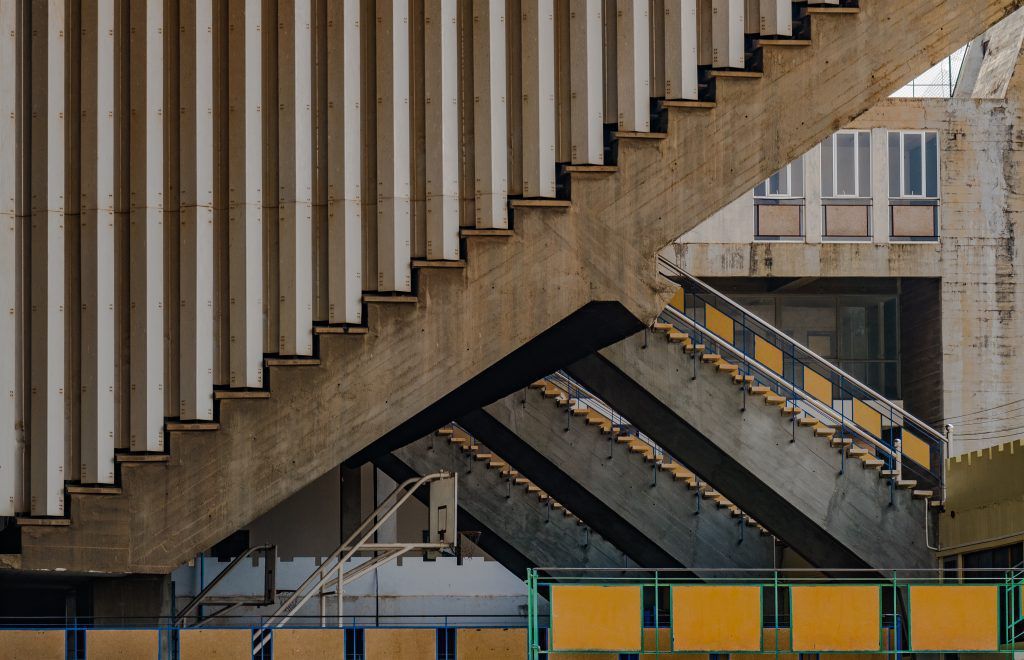
Molyvann’s taste for the support generating capacity of diagonals is again on show at the Olympic Stadium, which achieves a remarkable structural continuity despite accommodating a variety of performative spaces, including a sports field, athletics track, basketball court and swimming pool. The Stadium is one of the most dynamic buildings of its kind, in both design and atmosphere. The structure is typically buzzing with activity, with people engaged in formal and informal sporting and leisure pursuits. From the perspective of a Sydney local, who is used to large stadiums that are either remotely located or uninviting to the outsider, the Olympic Stadium is an example of how a large piece of sporting infrastructure should be integrated into the heart of a city.
The style and principles of New Khmer architecture have in part been forgotten due to historical misfortune and the growing dominance of glass and air conditioning, convergent technologies which are an unfortunate characteristic of rapidly modernising urban environments. Hopefully, the Cambodian government has the foresight to protect and preserve its iconic New Khmer buildings, so the Cambodian people can continue to enjoy their utility from a health and cultural perspective, while capitalising on the increasingly value they present as tourist destinations.
Tom Lee is a lecturer in design history in the Faculty of Design, Architecture and Building at the University of Technology Sydney. He has a PhD in comparative literature, focusing on the innovative syntax of WG Sebald and has published on topics including cemetery design, environmental aesthetics, literary lists, Peter Sloterdijk, contemporary aesthetic theory and the prose of Cormac McCarthy. Tom has travelled to Cambodia on two occasions over the last three years. @theaustralianugliness
