A common question from foreign property buyers is simple: What happens to my condo in Cambodia when I die?
Can your spouse or children inherit it? Can a foreign family member receive the property? Do you need a Cambodian will? And what happens if your spouse, child or another person is already named on the title?
The short answer is that a foreign-owned strata-title condominium in Cambodia can pass through succession. However, having a properly prepared will or testament can make the process much clearer for your family.
This guide explains the key points foreign condo owners should understand about wills, succession and inheritance in Cambodia.
1. Can a Foreigner’s Cambodian Condo Be Inherited?
Yes.
Cambodia’s Law on Providing Foreigners with Ownership Rights in Private Units of Co-Owned Buildings specifically recognizes succession involving foreign owners of strata-title units.
This is important because strata-title condominium ownership is different from Cambodian land ownership, which is generally restricted to Cambodian citizens.
A foreign-owned strata-title condominium does not simply disappear, revert to the developer or automatically become government property when the owner dies. Instead, the deceased owner’s interest forms part of their estate and may pass through succession in accordance with Cambodian law.
A will is not required simply to own a condominium in Cambodia. However, it is strongly worth considering if you want greater certainty over who receives your Cambodian assets after your death.
Without an applicable will, Cambodian succession law determines the legal heirs and their respective rights.
With a properly prepared testament, on the other hand, you can formally document how you want your Cambodian assets dealt with, subject to Cambodian succession law and any statutory rights that may apply to qualifying heirs.
Cambodian law provides for different forms of testament, including:
Private testament: generally prepared in the testator’s own handwriting.
Secret testament: sealed and formally declared in accordance with Cambodian legal requirements.
Authentic or notarized testament: formally prepared through the appropriate legal or notarial process.
For foreign property owners, an authentic or notarized Cambodian testament can be particularly practical.
3. Why Consider a Notarized Cambodian Testament?
One of the major considerations is what happens after the owner dies.
Based on Cambodian legal advice obtained by IPS, an authentic or notarized testament can provide a more straightforward process than relying on certain other forms of testament that may require additional court examination or certification.
After the owner’s death, the testament can bhttps://ips-cambodia.com/buy-off-plan-condo-cambodia-due-diligence-guidee formally opened and the relevant documentation provided to the executor or successor. The executor or successor can then begin implementing the testament and dealing with the deceased owner’s Cambodian assets.
For a family dealing with property, bank accounts and other assets in another country, having clear Cambodian documentation can significantly simplify the process.
However, individual circumstances vary. Therefore, the appropriate form of testament should always be discussed with a qualified Cambodian lawyer or notary.
4. What If I Already Have a Will Overseas?
Having a will in your home country does not necessarily mean you need an entirely separate estate plan for Cambodia.
However, relying on a foreign will in Cambodia can involve additional procedures.
An overseas will may be valid under the law of the country where it was made. Nevertheless, before it can be relied upon to deal with Cambodian assets, additional Cambodian procedures may be necessary.
Depending on the circumstances, these could involve matters such as:
Recognition of foreign legal documents
Cambodian court procedures
Certified translation
Authentication or legalisation
Evidence concerning the validity of the foreign will
Consequently, foreign owners with significant Cambodian assets may wish to consider preparing a Cambodian testament specifically covering their Cambodian assets.
Importantly, a Cambodian testament should be professionally coordinated with any overseas will or estate plan. The documents should complement each other rather than create conflicting instructions.
5. What Happens If I Die Without a Will in Cambodia?
If a property owner dies without an applicable testament, Cambodian statutory succession law determines who inherits the estate.
This does not necessarily mean that everything will simply be divided equally among every surviving family member.
A surviving spouse has succession rights, while children and other qualifying relatives may also have rights depending on the family circumstances and applicable law.
As a result, several people could potentially acquire interests in the same property.
For example, an owner may assume that their condominium will automatically pass entirely to their spouse. However, the actual succession outcome may involve other qualifying heirs as well.
Therefore, if you want your condominium or other Cambodian assets dealt with in a particular way, relying solely on intestate succession can produce a very different result from documenting your wishes through a properly prepared testament.
6. What If My Spouse or Child Is Already on the Strata Title?
Being a co-owner does not necessarily mean you automatically inherit the other owner’s share.
Consider a simple example.
A father and son each own 50% of a condominium. If the father dies, the son continues to own his existing 50%.
However, the father’s 50% interest forms part of the father’s estate.
That share must then be dealt with according to the father’s applicable testament or, if there is no applicable testament, Cambodian succession law.
Therefore, a surviving spouse, children or other lawful successors may potentially have rights over the deceased owner’s share.
In other words, joint ownership should not automatically be treated as a substitute for succession planning.
7. Do I Nominate a Beneficiary When Buying a Condo?
Generally, no.
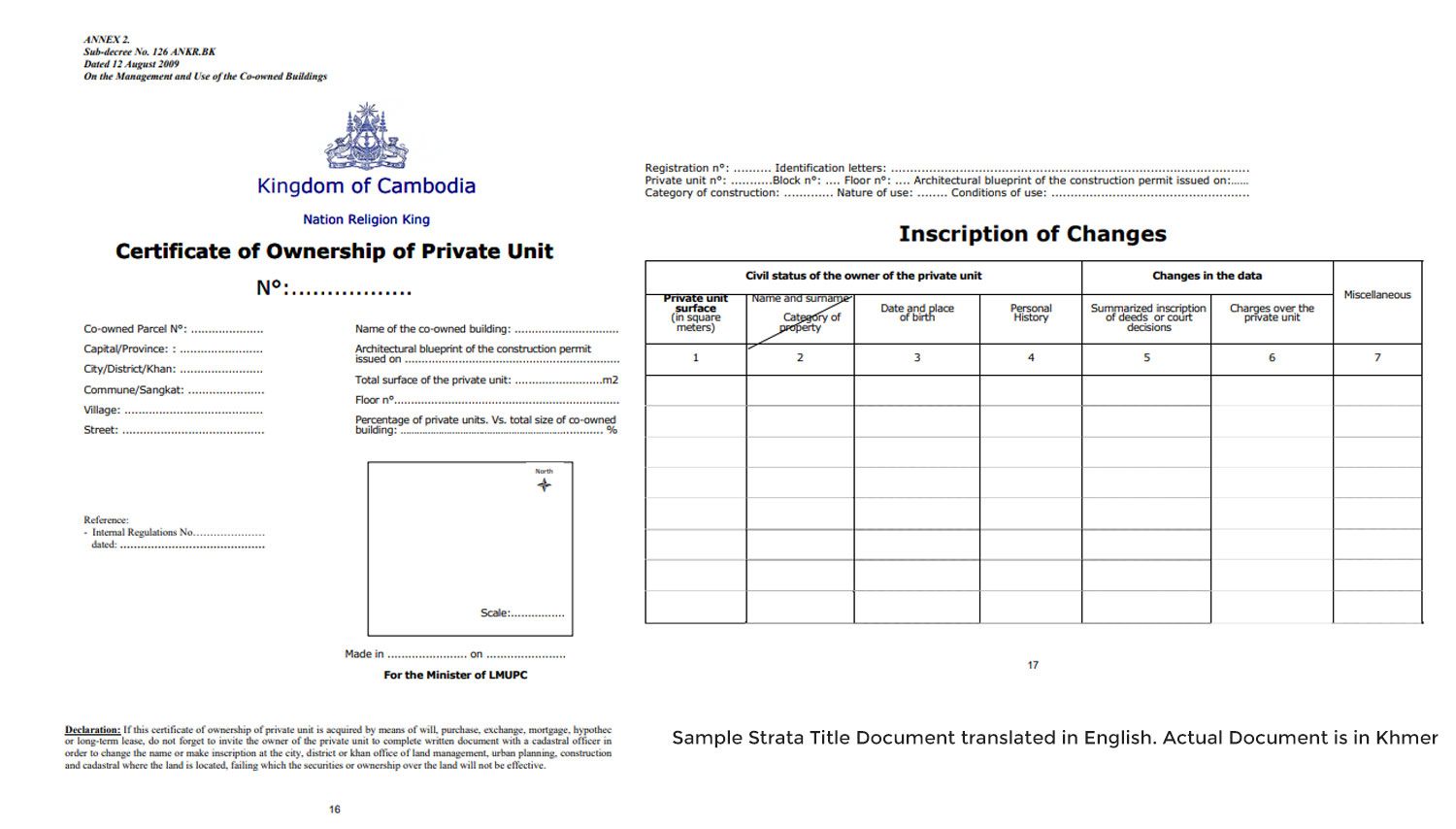
The Sale and Purchase Agreement (SPA) and eventual strata title establish who owns the property during the owner’s lifetime.
A testament or Cambodian succession law determines what happens to that ownership interest following the owner’s death.
Therefore, buying a condo and planning what happens to it after death should be treated as related but separate matters.
If two people intend to own the property together from the beginning, both parties should be correctly included in the relevant purchase documentation and, where appropriate, ultimately registered as owners on the strata title.
Before title issuance, an off-plan buyer may primarily hold contractual rights under the Sale and Purchase Agreement rather than a completed registered strata-title ownership interest.
If the buyer dies during construction, the treatment of those rights may therefore depend on several factors, including:
The terms of the SPA
The stage of the purchase and construction
Payments already made
The applicable succession arrangements
The documentation required by the developer
For this reason, foreign buyers purchasing off-plan property should consider their purchase contract and succession planning together.
9. Is There Inheritance Tax in Cambodia?
Cambodia currently does not impose a specific inheritance or estate tax.
Therefore, there is no separate Cambodian inheritance tax simply because assets pass from a deceased owner to their beneficiaries.
However, this does not necessarily mean that transferring inherited property is completely free of costs.
Depending on the asset and circumstances, there may still be administrative fees, registration costs, professional fees or other applicable taxes and charges involved in dealing with or transferring the asset.
Foreign beneficiaries should also consider their obligations outside Cambodia.
For example, inheritance, estate, capital gains or reporting obligations could potentially arise in the beneficiary’s country of residence, citizenship or tax domicile.
Professional tax advice may therefore be necessary where substantial assets or multiple jurisdictions are involved.
10. What Other Cambodian Assets Can a Testament Cover?
A Cambodian testament can potentially deal with more than a condominium.
Depending on the owner’s circumstances and the applicable legal requirements, Cambodian estate planning may involve assets such as:
Strata-title condominiums
Cambodian bank accounts
Company shares
Vehicles
Rental income
Contractual rights
Investments
Other Cambodian assets
This can be particularly useful for foreigners who maintain their broader estate planning in their home country but also hold significant assets in Cambodia.
A Cambodian testament can potentially be structured specifically around the relevant Cambodian assets while the owner’s broader international estate remains governed by separate arrangements.
Again, these documents should be professionally coordinated to avoid conflicts between jurisdictions.
11. What Should Foreign Condo Owners Do?
For most foreign property owners, the practical questions are straightforward:
What assets do I own in Cambodia?
Who do I want to receive those assets?
Do I have an appropriate will or testament in place?
Does my family or executor know where the relevant documents are?
Good record keeping can make a major difference.
Consider keeping your strata title, Sale and Purchase Agreement, testament, lawyer or notary details, bank information and other important Cambodian asset records together in a secure location.
The appropriate family member, executor or trusted representative should also know how to access the necessary documents when required.
For foreign owners with significant Cambodian assets, it is worth discussing an authentic or notarized Cambodian testament with a qualified Cambodian lawyer or notary.
12. Cambodia Condo Inheritance: The Key Takeaway
A foreign-owned Cambodian strata-title condominium can pass through succession, and Cambodia currently does not impose a specific inheritance or estate tax.
However, there is an important difference between having the legal ability to inherit an asset and making that inheritance straightforward for your family.
Without an applicable will, Cambodian succession law determines who inherits. Joint ownership does not necessarily mean the surviving owner automatically receives the deceased owner’s share. Meanwhile, relying on an overseas will may involve additional procedures before Cambodian assets can be dealt with.
Succession planning can therefore provide much greater clarity over who should receive your Cambodian property and other assets.
For many foreign property owners, discussing a Cambodian notarized testament with an appropriate legal professional is worth considering as part of their broader estate planning.
Important Notice
This article provides general information about Cambodian property ownership, wills and succession and does not constitute legal, tax or estate-planning advice.
Individual circumstances vary. Foreign property owners should obtain advice from a qualified Cambodian lawyer or notary and, where relevant, coordinate their Cambodian arrangements with professional advisers in their home jurisdiction.
For years, the question of whether a foreigner can truly "own" property in Cambodia has been met with mixed answers. However, recent public clarifications from H.E.
IPS Cambodia collaborated with the legal experts at Rajah & Tann Sok & Heng (RTSH) for a comprehensive session titled "Legal Compliance and Real Estate Opportunities", in which we also discussed the legal framework surrounding land ownership, a subject vital for any…